
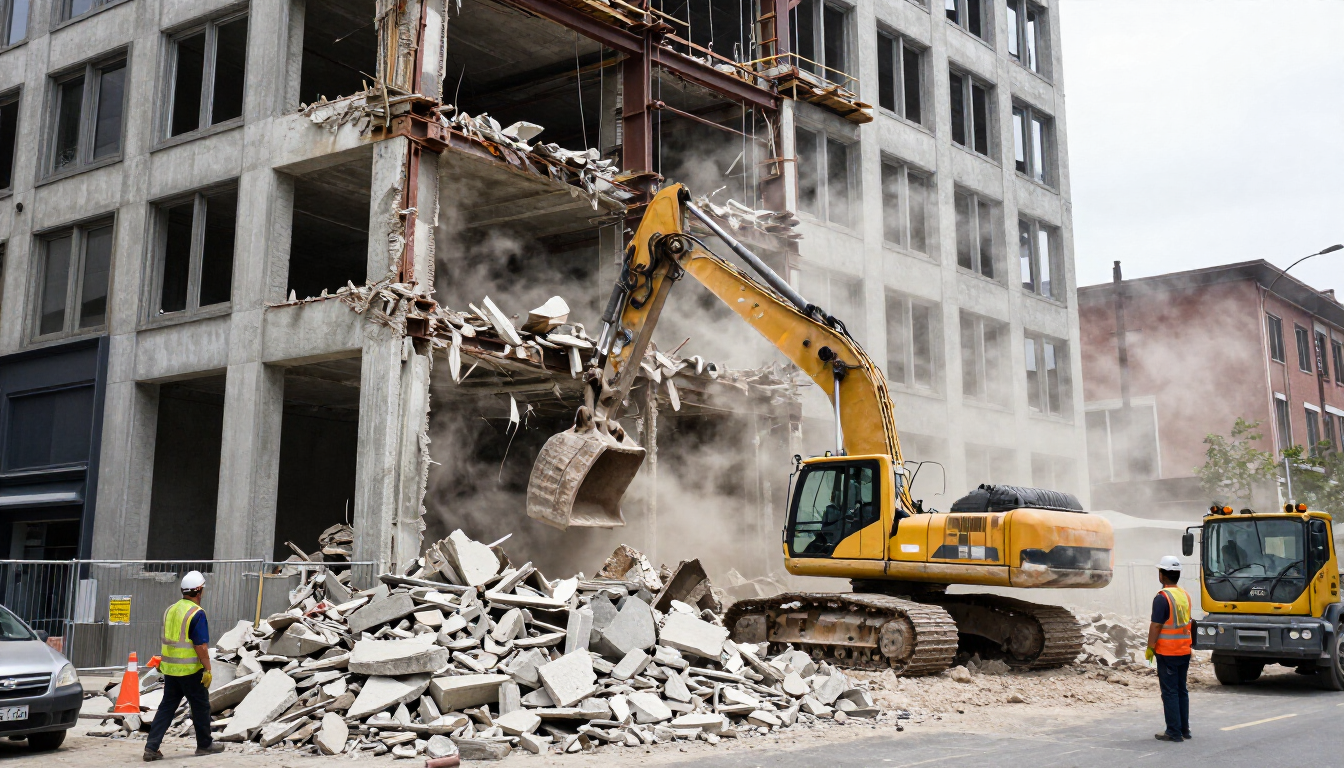

Commercial Demolition Contractors Manchester
Commercial Demolition and Site Clearance
Group Services North West provides demolition and site preparation support for commercial, industrial and redevelopment projects across Manchester and Greater Manchester. From selective removal and structural alterations to planned building demolition and site clearance, we focus on safely preparing premises for their next use.
Demolition Contractors for Manchester Commercial Projects
Commercial demolition is a specialist construction activity that requires careful assessment of the building, its surroundings and the intended outcome. Unlike straightforward internal clearance, demolition may affect structural components, adjoining property, underground services, access routes and the safety of people around a site.
Group Services North West supports demolition requirements for commercial landlords, property developers, businesses, construction contractors and facilities managers in Manchester. Projects may involve the planned removal of redundant commercial structures, selective demolition before redevelopment, internal structural alterations or the clearance of a site before new construction begins.
We focus on suitable commercial and larger-scale opportunities, where a defined scope, professional planning and coordination between contractors are essential. Manchester presents particular challenges in busy city-centre locations, multi-occupied properties, industrial estates and established business premises. These considerations need to shape the demolition programme from the outset.
What Is Commercial Demolition?
Commercial demolition is the controlled dismantling, partial removal or complete removal of commercial buildings and structural elements to allow redevelopment, refurbishment, alteration or site reuse.
It can involve structural removal, selective demolition, removal of redundant extensions, internal alterations and associated debris clearance. The appropriate method depends on the building's design, condition, surroundings, services and project requirements.
Demolition is different from soft strip out, which concentrates on removing non-structural fixtures and finishes. Structural demolition requires additional engineering consideration, planning and control measures.
Commercial Demolition Services in Manchester
Structural Demolition
Planned removal of suitable commercial structures or structural elements, with the method and sequence established through appropriate technical assessment and project planning.
Selective Demolition
Targeted removal of agreed building sections while protecting structural elements, adjoining areas and features identified for retention.
Commercial Building Alterations
Demolition-related works supporting extensions, reconfiguration and redevelopment of offices, industrial facilities and other business premises.
Industrial Structure Removal
Removal of suitable redundant structures, extensions and building elements on commercial or industrial sites, subject to the required surveys and design.
Pre-Development Clearance
Preparation and clearance of demolition sites so subsequent groundworks, site preparation or construction operations can proceed.
Demolition Waste Management
Planning material segregation, debris removal and suitable waste arrangements alongside demolition works and construction handover.
Commercial Demolition Versus Soft Strip Out
Both services can contribute to a redevelopment programme, but they serve different purposes. Keeping them separate helps clients select the right service and ensures that project requirements are clearly defined.
Commercial Demolition
Focuses on structural or selective removal, building alteration, removal of redundant sections and preparation for redevelopment. It generally requires specific consideration of structural stability, demolition methods, temporary support and the effects on surrounding property.
The primary objective is to safely alter or remove the agreed building structure.
Commercial Soft Strip Out
Focuses on non-structural internal fixtures and finishes, including partitions, ceilings, flooring, counters and previous tenant installations. It is commonly used before refurbishment, fit-out, handover or structural demolition.
For office, retail and interior clearance enquiries, visit our Manchester commercial soft strip out page.
Demolition Planning for Manchester City-Centre Sites
Commercial demolition in central Manchester can involve restricted streets, neighbouring offices, busy pedestrian areas and limited space for machinery or waste vehicles. Unlike open development sites, urban projects may have little room for material storage or access arrangements.
Early planning should therefore consider nearby structures, building occupation, vehicle movements, safe access, dust, noise, vibration and the location of services. Particular care may be necessary where businesses remain operational next door or where the site forms part of a larger mixed-use property.
In areas such as Deansgate, Spinningfields and the city centre, delivery and waste movements may need to be coordinated with local restrictions and building management requirements. The demolition strategy should reflect the actual site rather than follow a standard approach.
Demolition for Commercial and Industrial Properties
| Property | Potential Demolition Requirement | Planning Considerations |
|---|---|---|
| Industrial Premises | Redundant extensions, structural alterations or removal of outdated building sections. | Operational access, equipment, vehicles and retained buildings. |
| Commercial Offices | Structural reconfiguration and demolition associated with redevelopment. | Adjoining tenants, services, building stability and restricted access. |
| Retail Properties | Partial removal, redevelopment preparation and alterations to commercial units. | Public routes, neighbouring businesses and landlord requirements. |
| Development Sites | Removal of suitable existing structures before new construction. | Surveys, demolition method, site boundaries and waste handling. |
Our Approach to Commercial Demolition Projects
Establish the structure, location, required demolition and planned future use.
Review structural information, service records, hazardous-material risks and site constraints.
Agree the appropriate demolition sequence, responsibilities, permissions and safety controls.
Carry out the agreed demolition and material management under suitable supervision.
Clear agreed debris and prepare the site for the next construction stage.
Safety, Structural Surveys and Demolition Requirements
Demolition must be properly planned and undertaken by competent people using methods suitable for the structure and surrounding environment. Under the Construction (Design and Management) Regulations 2015, the project team has defined duties relating to health, safety and coordination. Structural stability, demolition sequencing, temporary works and the potential effects on adjacent buildings need to be assessed.
Before disturbing existing building materials, relevant asbestos information and surveys must be available. Where asbestos is identified, its management or removal must follow the applicable requirements, including the use of appropriately licensed specialists where necessary. Demolition work must not proceed on assumptions that a building is free from hazardous materials.
Depending on the building and the proposed works, local authority demolition notices, planning considerations, conservation restrictions, listed building consent or other approvals may apply. These requirements should be checked for the specific project before demolition begins.
What Affects Commercial Demolition Costs in Manchester?
Commercial demolition pricing depends on the structure, the demolition method and the logistical requirements. A small, isolated commercial structure presents different challenges from a building within a busy development or close to adjoining premises.
Building Size and Construction
Height, structural form, materials, retained sections and the complexity of dismantling affect the required labour, equipment and programme.
Location and Access
City-centre restrictions, vehicle access, neighbouring buildings and limited working space can influence methodology and cost.
Surveys and Specialist Work
Structural assessment, hazardous materials, temporary support and additional technical requirements may affect the project scope.
Material Removal
Debris volume, segregation, loading, transport and disposal arrangements all contribute to the overall project cost.
An accurate quotation should be based on a clear demolition scope and appropriate site information rather than a generic price per square metre.
Manchester and Greater Manchester Coverage
We can consider suitable commercial demolition enquiries across Manchester, Salford, Trafford, Stockport, Bolton, Bury, Oldham, Rochdale, Tameside and Wigan, with a particular focus on substantial commercial and industrial projects.
Project suitability depends on scale, the structure involved, access, survey information and the proposed works.
Related Commercial Construction Services
Commercial Soft Strip Out Manchester — internal clearance before refurbishment or demolition.
Site Preparation Contractors Manchester — preparing cleared commercial land for construction.
Commercial Refurbishment Services — upgrading and adapting commercial property.
Commercial Dilapidation Services — lease-end property works and reinstatement.
Frequently Asked Questions
What types of commercial demolition projects can a contractor undertake?
Commercial demolition can include complete building removal, selective structural demolition, removal of redundant extensions, alterations to existing business premises and site clearance ahead of redevelopment. The exact work depends on the property, its structural design, location and the client's intended use of the site.
In Manchester, demolition projects may involve offices, commercial units, industrial premises, business sites or buildings being redeveloped for a different purpose. Some projects require removal of an isolated structure, whereas others involve controlled dismantling while neighbouring buildings or parts of the same property remain standing. These are different technical challenges and should not be treated as interchangeable.
Before appointing a contractor, a commercial client should establish the proposed scope, identify retained structures and provide relevant information about the building. The demolition team can then assess the appropriate method, access restrictions, waste arrangements and project programme. Structural engineering input, surveys and specialist support may also be necessary. A defined scope is essential for pricing and planning the work safely.
What is the difference between selective demolition and soft strip out?
Selective demolition involves removing specified parts of a building while retaining other elements. It may affect structural components and therefore requires careful assessment of how the remaining building will be supported. Soft strip out generally removes non-structural interior materials, such as flooring, ceilings, partitions and fixtures, while preserving the main structure.
For example, a Manchester business refurbishing an office might require soft strip out to remove old meeting rooms, carpet tiles and fittings. A developer changing the building's structural layout may require selective demolition instead, potentially involving engineered support and a different method of work. Some redevelopment projects need both activities, but they may happen at different stages of the programme.
The distinction matters when obtaining quotations. A strip-out contractor should not be assumed to be carrying out structural demolition simply because both services involve material removal. Clients should explain whether the work affects structural walls, floors, frames or load-bearing elements and provide drawings where available. The scope and relevant design information will determine the appropriate approach.
Do commercial demolition projects require planning permission or council notification?
Some commercial demolition projects require local authority notification, planning approval, prior approval or specialist consent. The requirements depend on the building, its location and the type of proposed demolition. They should be checked before work begins rather than assuming all demolition is automatically permitted.
For relevant work in England, Section 80 of the Building Act 1984 contains demolition notice requirements, subject to exceptions. Planning rules can also apply, including where a building is listed, within a conservation area or affected by particular local restrictions. Permission to redevelop a site is not necessarily the same as permission to demolish every existing element.
Commercial clients should allow sufficient time for approvals, surveys, structural review and site planning. The local authority and relevant professional advisers can help determine which requirements apply to the specific property. This is particularly important in established Manchester commercial areas where surrounding buildings, highways and other occupiers can affect the planned demolition method.
How is safety managed during commercial demolition?
Commercial demolition safety depends on understanding the structure, identifying foreseeable hazards and implementing an appropriate demolition method. Key considerations include structural stability, collapse risks, underground and overhead services, asbestos, dust, noise, site access and the protection of workers and the public.
Demolition should be planned and supervised by competent people, with suitable information provided about the property. This may include structural surveys, refurbishment or demolition asbestos surveys, service drawings and details of neighbouring structures. Where a building is partly retained, the method must address how the remaining structure will remain stable throughout the work.
On Manchester commercial sites, safe segregation can be especially important because nearby businesses and public routes may remain active. The project team should consider exclusion zones, vehicle movements, pedestrian management and how materials will be handled. Appropriate documentation, communication and monitoring help control risks as the demolition progresses. No standard method can substitute for an assessment of the actual building and its surroundings.
How long does commercial demolition take?
Commercial demolition timescales vary according to the size, structural form and location of the building, the extent of removal and the work needed before demolition can begin. Site access, surveys, approvals, hazardous materials and waste handling can all influence the programme.
A straightforward demolition of a small isolated structure may involve much less site work than selective demolition within an occupied commercial development. Complex projects can also require engineering design, temporary works, detailed sequencing and careful management of neighbouring structures. These activities must be allowed for when setting a realistic programme.
For a Manchester city-centre project, working-hour restrictions, loading limitations and pedestrian management may further affect the schedule. The best approach is to provide the contractor with drawings, available surveys, the intended demolition scope and required completion dates. This gives the project team a basis for planning rather than relying on a generic estimate that may not reflect the site.
Can demolition contractors clear the site afterwards?
Site clearance can form part of a commercial demolition package. It may involve separating, loading and removing demolition debris, managing waste streams and preparing the area for further construction or inspection. The precise condition required at handover should be specified in the contract.
Different projects have different handover needs. A developer may want the existing structure removed and debris cleared before groundworks begin, while another client may require certain slabs, foundations, boundary structures or services to remain in place. These distinctions influence both the scope and price.
Waste handling should account for the types of materials being generated, any relevant specialist waste requirements and the practical access available for collection. Where excavation or redevelopment follows demolition, the contractor and client should agree how the site will be handed over to the next team. Clear expectations reduce misunderstandings and help the construction programme progress in an organised manner.
Discuss Your Manchester Commercial Demolition Project
Planning a commercial redevelopment, selective demolition or removal of a redundant building? Tell Group Services North West about your Manchester project, including its location, scope and proposed programme.
Get Quote