
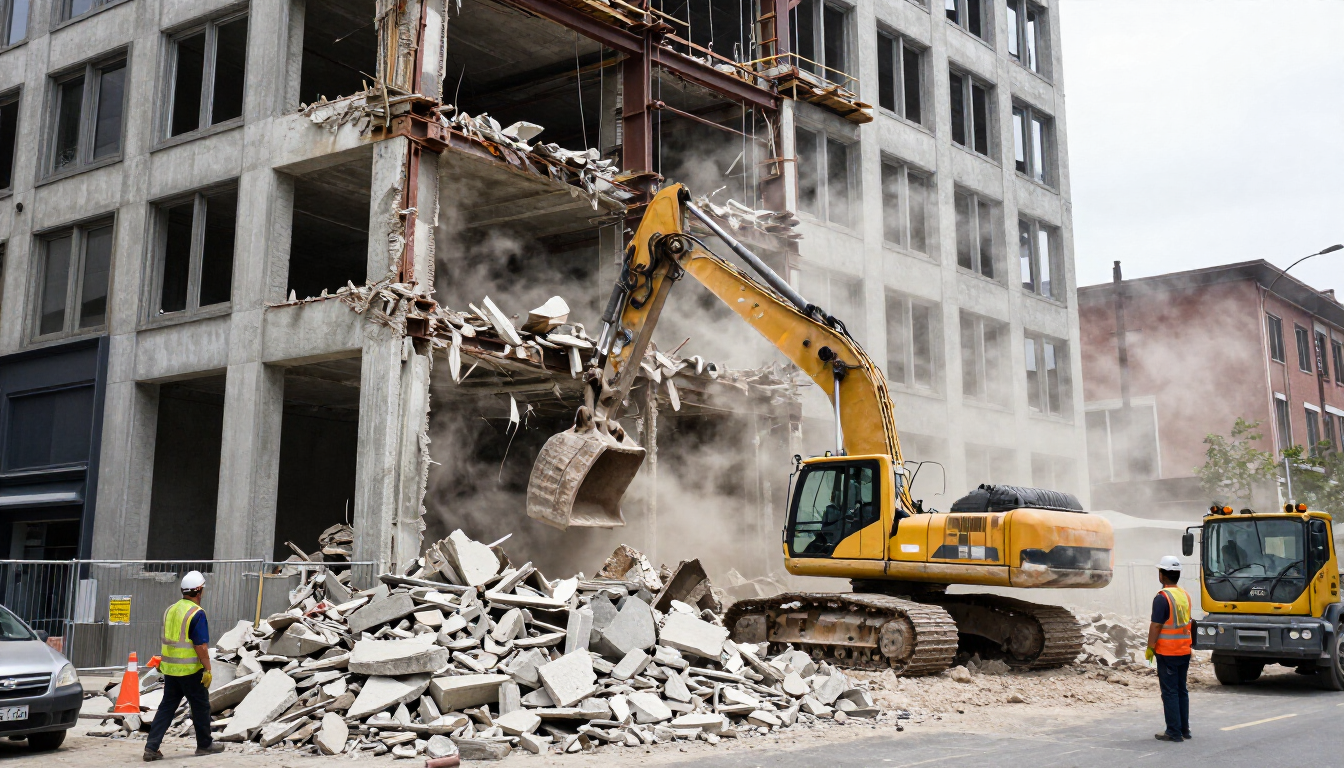

Commercial Demolition Contractors Liverpool
Group Services North West supports commercial demolition, selective building removal and site clearance across Liverpool and Merseyside. From business premises and redundant structures to redevelopment and commercial building alterations, we help clients plan the safe transition from an existing property to its next stage of use.
Commercial Demolition Services in Liverpool and Merseyside
Commercial demolition often marks the beginning of a significant change to a property. An older building may need to be removed before redevelopment, an existing commercial structure may require partial demolition, or a redundant extension may need to be dismantled before new construction can proceed.
Group Services North West supports developers, landlords, managing agents, construction contractors and businesses seeking demolition services in Liverpool. Each project needs to be considered in terms of the building's structure, surrounding environment, proposed future use and applicable permissions.
Liverpool has a varied building stock, including modern commercial premises, converted warehouses, older offices, retail properties and industrial buildings. Demolition work within these settings may involve narrow access routes, neighbouring structures, conservation considerations and operational restrictions. A suitable demolition approach must address these realities before work begins.
What Is Commercial Demolition?
Commercial demolition involves the planned removal or dismantling of commercial structures or selected structural elements to support redevelopment, conversion, building alteration or the preparation of a site for construction.
The work may range from selective demolition within a retained building to the removal of an entire structure, subject to appropriate assessment and permissions. It can also involve associated site clearance and management of demolition materials.
Where the requirement is only to remove non-structural interior fixtures and finishes, a commercial soft strip service may be more appropriate.
Demolition Work We Can Support
Commercial Building Demolition
Planned removal of suitable redundant commercial buildings and structures ahead of redevelopment or alternative site use.
Partial Demolition
Targeted removal of selected building sections where other parts of the property must remain in place.
Structural Alteration Preparation
Demolition-related work supporting approved changes to commercial layouts, extensions and redevelopment schemes.
Warehouse & Industrial Demolition
Consideration of suitable industrial structures, redundant building sections and commercial facilities being replaced or adapted.
Redevelopment Site Clearance
Clearing agreed demolition materials and preparing the area for surveys, groundworks, new construction or further development activity.
Selective Building Dismantling
Carefully planned removal where certain structural components, adjoining property or identified building elements must be retained.
Demolition in Liverpool's Commercial and Industrial Areas
Different parts of Liverpool present different challenges for demolition. City-centre commercial buildings may have limited loading space and intensive neighbouring activity, whereas larger industrial sites may require more extensive site logistics, plant access and waste management arrangements.
| Area or Property Type | Typical Considerations | Project Requirements |
|---|---|---|
| Liverpool City Centre | Restricted streets, adjoining buildings, pedestrians, commercial tenants and access controls. | Careful segregation, logistics planning and coordination with relevant parties. |
| Baltic Triangle | Adapted commercial properties, mixed-use buildings and former industrial spaces. | Building surveys, assessment of retained elements and controlled demolition methods. |
| Dock and Waterfront Areas | Industrial history, varied structural forms and potentially sensitive building environments. | Appropriate technical review, access planning and any relevant heritage assessment. |
| Speke and Industrial Districts | Commercial sites, industrial facilities, larger service areas and operational premises. | Plant routes, safety segregation, retained structures and debris clearance. |
Demolition and Liverpool's Historic Buildings
Liverpool's older commercial buildings can present additional considerations because construction methods, materials and previous alterations may be less straightforward than those of a modern building. Some sites are also affected by listed-building status, conservation areas or other heritage restrictions.
These factors should be assessed before a demolition scope is agreed. Work affecting a listed building may require Listed Building Consent, while demolition in conservation areas can trigger separate planning requirements. The fact that a property is vacant, damaged or no longer commercially useful does not automatically mean it can be demolished.
Where there is uncertainty about structural history, protected features or heritage designation, early specialist advice can help establish whether the proposed works are permissible and how the retained property must be protected.
Selective Demolition and Commercial Redevelopment
Not every redevelopment requires an entire building to be demolished. Selective demolition may be more appropriate when an extension must be removed, an existing structure is being altered or part of a commercial building is being retained.
Retaining Existing Structures
Selective demolition needs to account for how retained walls, floors, frames and adjacent sections will remain stable during the work. Structural assessment and any required temporary works should form part of the project planning.
Preparing for a New Use
Targeted removal may help prepare an existing property for a different layout, extension or commercial use, where the proposed alterations have been properly designed and approved.
For non-structural interior removal, our Commercial Soft Strip Out Liverpool page covers the separate service used for offices, shops, hospitality properties and lease-end clearance.
Demolition Safety, Asbestos and Structural Information
Commercial demolition must be planned around the actual building and its risks. The project team needs suitable information about structural stability, previous alterations, adjoining property, underground and overhead services, potential asbestos-containing materials and the effects on people nearby.
Relevant refurbishment or demolition asbestos surveys should be available before work that may disturb the building fabric. Where asbestos is present, appropriately competent specialists and licensed contractors, where legally required, must deal with it under the applicable arrangements. Demolition is not an acceptable substitute for specialist asbestos assessment or removal.
The demolition method should reflect structural advice, the intended sequence, any temporary support and the required protection of workers, neighbours and members of the public. In Liverpool's densely developed commercial areas, safe boundaries, debris control, noise and dust management can require particularly careful coordination.
Our Commercial Demolition Planning Process
Understand the building, location, required removal and plans for redevelopment.
Consider structure, services, surveys, constraints and retained elements.
Identify relevant notices, approvals, consents and project responsibilities.
Plan the sequence, site controls, supervision and material handling.
Agree final clearance and the condition needed for following construction works.
Demolition Waste and Responsible Site Clearance
Demolition can generate substantial volumes of concrete, brick, metal, timber, plasterboard and mixed construction materials. Different materials may need different segregation or disposal arrangements, and hazardous waste must be managed separately in accordance with applicable requirements.
Planning for debris removal matters particularly where there is limited room for loading and storage. A successful clearance strategy should consider vehicle access, safe material movement, site boundaries and the condition in which the premises must be left for subsequent work.
Where further construction is planned, it is important to clarify whether existing foundations, slabs, buried structures or services are included in the demolition scope. Agreeing this before the project starts helps avoid uncertainty at handover.
What Influences Commercial Demolition Costs in Liverpool?
Building Construction
The materials, structural form, height and extent of demolition influence the method and resources required.
Urban Access
Loading restrictions, neighbouring premises, vehicle access and limited working space affect site logistics.
Heritage and Technical Constraints
Protected structures, retained building elements, surveys and specialist technical requirements can influence the scope.
Debris and Clearance
Waste volume, material segregation, transport arrangements and specified handover condition affect the overall package.
A commercial demolition quotation should reflect a review of the property and the agreed scope, not simply its floor area.
Commercial Demolition Coverage Across Liverpool
GSNW can consider suitable demolition work in Liverpool city centre, the Baltic Triangle, waterfront commercial districts, Speke, Bootle and other parts of Merseyside. The emphasis is on commercial, industrial and redevelopment projects where the nature and scale of work support a planned demolition package.
Related Services for Liverpool Commercial Projects
Commercial Soft Strip Out Liverpool — non-structural interior clearance before fit-out or demolition.
Commercial Refurbishment — upgrading and adapting commercial premises.
Office Refurbishment Liverpool — business guidance on commercial workspace improvements.
Commercial Dilapidation Services — lease-end reinstatement and property handover works.
Frequently Asked Questions
What kinds of commercial buildings can be demolished?
Commercial demolition can apply to suitable offices, industrial buildings, warehouses, redundant extensions, commercial units and other structures where removal is part of an approved alteration or redevelopment project. Whether demolition is appropriate depends on the property's structure, condition, location and any restrictions affecting it.
In Liverpool, commercial buildings differ considerably in age and construction. A modern isolated industrial building may present different challenges from an older property surrounded by other businesses. Existing foundations, shared walls, retained features and previous alterations can affect the demolition approach. Some projects involve complete building removal, while others require only a selected section to be dismantled.
Before obtaining an accurate quote, clients should explain which elements are to be demolished, which must remain and what the next construction phase will involve. Available drawings, survey information and details of approvals can help contractors assess the work. This allows a safer and more realistic demolition programme to be developed for the specific site.
Can demolition work take place next to occupied commercial premises?
Demolition near occupied buildings may be possible, but it requires site-specific assessment of the structure, surrounding property and risks to other occupants. The project may need carefully planned segregation, temporary support, access management and restrictions on certain activities.
Commercial districts in Liverpool often contain neighbouring businesses, shared access routes, loading areas and public spaces. A demolition scheme in this environment must consider what is happening beyond the immediate work area. Dust, debris, vibration, noise and vehicle movements can affect people who are not directly involved in the demolition.
The appropriate method should be established through competent planning and technical review. Where retained structures could be affected, engineering assessment may be required. Clients should provide details of adjoining occupancy and operational restrictions at the enquiry stage. This helps establish whether work can proceed while neighbouring premises remain open and what control measures are necessary.
Are there additional restrictions when demolishing older buildings in Liverpool?
Older Liverpool buildings can be affected by structural complexity, historic alterations and heritage protection. Listed buildings, properties in conservation areas and sites subject to specific planning controls may require additional permissions or specialist assessment before demolition is considered.
Historic commercial properties can contain unusual structural arrangements, shared walls or materials that are not immediately apparent. Demolition planning needs to take these factors into account. It is important to establish which parts of the property are protected and whether structural removal would affect neighbouring premises or features that must be retained.
Clients should confirm designation and consent requirements with the local planning authority and relevant professional advisers. A demolition quotation cannot itself authorise work that requires statutory approval. Where conservation or heritage restrictions apply, a different redevelopment strategy may be required. Early investigation can prevent the project being based on an assumption that demolition is permitted.
How is demolition waste handled on Liverpool commercial projects?
Demolition waste arrangements should be included in the project plan, with consideration given to the expected materials, waste classification, segregation, loading, transport and lawful disposal. The method will depend on the property and the type of demolition being carried out.
A commercial building may contain concrete, brick, metals, timber, plasterboard, glazing and materials from previous fit-outs. Some waste streams may need separate handling, and hazardous materials cannot simply be included with general demolition debris. Relevant surveys and material information should be reviewed before work starts.
On constrained Liverpool sites, limited space for skips or vehicles can influence the demolition sequence. Material handling may need to be coordinated with access arrangements and working restrictions. The required handover condition should also be stated clearly. Clients may need a cleared site, a retained slab or specific foundations left in place, depending on what will be constructed next.
What information is needed for a commercial demolition quote?
A useful demolition enquiry should identify the site address, building type, approximate size, scope of removal, proposed project dates and any known access restrictions. Drawings, photographs and existing survey information are also valuable when available.
The contractor needs to know whether the intention is to demolish an entire structure, remove a particular section or carry out alterations while retaining the main building. Information about adjoining premises, listed status, conservation restrictions and known asbestos or structural concerns should be shared early. This does not replace the need for formal surveys but helps identify the likely project requirements.
Clients should also explain what they expect to happen after demolition. For example, the site might be prepared for a new building, an extension, groundworks or redevelopment of the retained property. This determines whether particular slabs, foundations, services or surrounding areas must remain undisturbed. Clear information supports more meaningful scope discussions and quotations.
How are commercial demolition costs calculated?
Commercial demolition costs are calculated from the work required rather than a universal price per square metre. Important factors include structural design, the amount of material being removed, plant requirements, access limitations, surveys, specialist work and waste handling.
A detached commercial structure with straightforward access may be less complicated to remove than part of a building that shares walls with occupied premises. Liverpool city-centre restrictions, conservation requirements, traffic arrangements or limited working areas can also affect cost. Where structural elements must remain, additional design or temporary works may be necessary.
Clients should seek a quotation based on clear drawings, survey information and an agreed demolition scope. It is equally important to understand what the price includes, particularly around preparatory works, waste removal, retained structures and final site condition. Comparing quotations without checking these inclusions can lead to misleading conclusions about the true project cost.
Planning Commercial Demolition in Liverpool?
For commercial building removal, selective demolition or redevelopment site clearance in Liverpool and Merseyside, contact Group Services North West with details of your property and proposed project.
Get Quote