


The Strategic Guide to Refurbishing Occupied Offices: Minimising Disruption & Maximising ROI
For many businesses in the North West, the need to modernise office space is clear, but the thought of closing down operations to facilitate the work is simply not an option. In a fast-paced commercial environment, downtime equates to lost revenue. This is where a strategic, phased refurbishment in an occupied office becomes the ideal solution.
At Group Services Northwest, we specialise in delivering high-quality fit outs within "live" environments. This guide explores how we manage the logistics, safety, and schedules to ensure your business continues to thrive while your workspace is transformed.
What is a Phased Refurbishment Strategy?
A phased refurbishment involves breaking a large project into smaller, manageable sections. Rather than stripping out the entire floorplate at once, we segregate specific zones—such as a meeting room block, a kitchen area, or a quadrant of desks—and refurbish them sequentially.
This approach allows your staff to continue working in the unaffected zones. Once a phase is complete, your team migrates into the newly finished space, freeing up the next zone for our contractors. It requires meticulous planning and a "decant" strategy, but it completely eliminates the need for temporary relocation.
The 4-Stage Phased Refurbishment Workflow
To visualise how this works in practice, here is the typical workflow we implement for clients across the North West:
- Stage 1: The "Decant" Zone (Weeks 1–2) We identify an underused area (e.g., a large meeting room or spare capacity desks) and refurbish this first while it is empty. This becomes the "swing space."
- Stage 2: The Migration (Week 3) Department A moves into the newly finished "swing space." Their old desk area is now empty and becomes the active construction site.
- Stage 3: The Rolling Refurb (Weeks 4–8) We systematically move through the floorplate. As one zone is finished, a new team moves in, and we take over their old space.
- Stage 4: The Final Link-Up (Week 9) The final zone is completed. We remove all hoardings, perform a deep clean, and seamlessly connect the new carpet and flooring runs to unify the office.

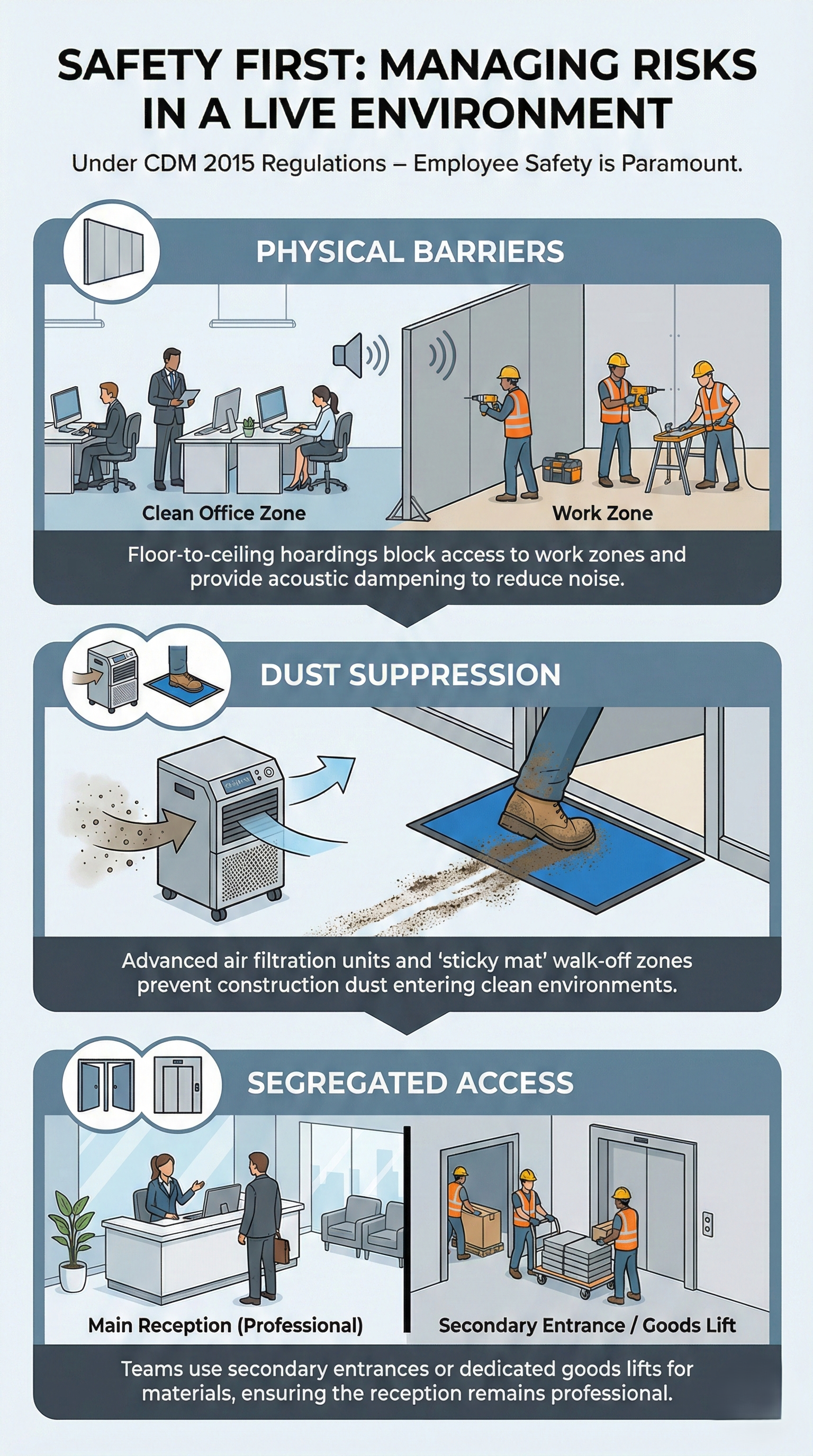
Safety First: Managing Risks in a Live Construction / Refurbishment Environment
Working alongside office staff requires a higher tier of safety management than an empty construction site. Under the CDM 2015 (Construction (Design and Management) Regulations), the safety of your employees is paramount.
We implement strict control measures to separate construction activities from your daily operations:
- Physical Barriers: We install floor-to-ceiling hoardings that not only block access to the work zone but also provide acoustic dampening to reduce noise.
- Dust Suppression: Advanced air filtration units and "sticky mat" walk-off zones prevent construction dust from entering your clean office environment. Responsible disposal of construction waste.
- Segregated Access: Wherever possible, our teams use secondary entrances or dedicated goods lifts to bring in materials, ensuring your reception area remains professional and welcoming to clients.
Regulatory Compliance: Your Legal Responsibilities
Refurbishing a live office involves specific legal obligations that differ from an empty site. As the client, you share liability under CDM 2015 regulations. Group Services Northwest acts as your Principal Contractor to manage these risks:
- Fire Escape Routes: We ensure that hoarding lines never block emergency exits. Temporary signage is installed daily to redirect staff if a usual route is closed.
- Noise at Work Regulations 2005: We monitor decibel levels. If drilling exceeds 80 dB, it is strictly relegated to out-of-hours work or acoustic barriers are reinforced.
- Asbestos Management: In older buildings (common in Liverpool and Manchester city centres), we review your Asbestos Register before disturbing any fabric of the building to ensure total compliance.
The Logistics of "Invisible" Construction
The mark of a successful occupied refurbishment is that you barely notice we are there. We achieve this through "invisible" construction scheduling.
Disruptive works—such as drilling into concrete, removing partition walls, or heavy mechanical installations—are scheduled strictly for
out-of-hours periods (evenings or weekends). During your core business hours (e.g., 9 am to 5 pm), our focus shifts to low-impact tasks like painting, electrical second-fixing, or joinery. This ensures your team can take calls and hold meetings without background interference.
Fit Outs Cost Implications: Is Phased Refurbishment More Expensive?
A common question we face is whether working out-of-hours increases the project cost. While labour rates for evenings and weekends can be marginally higher, the Return on Investment (ROI) is significantly better when you factor in the alternative.
Consider the cost of stopping trading for 4–6 weeks, renting temporary serviced offices for your entire staff, or moving IT infrastructure twice (out and back in). When viewed holistically, a phased refurbishment is often the most commercially viable option.
At a Glance: Occupied Office Refurbishment vs. Temporary Office Relocation
| Feature | Phased Refurbishment (Occupied) | Temporary Relocation (Empty Site) |
|---|---|---|
| Business Continuity | 100% - Staff stay on-site | < 80% - Disruption during moves |
| IT Downtime | Minimal (Zone by Zone) | High (Full Server Move Required) |
| Project Duration | Longer (due to phasing) | Shorter (Contractors have free rein) |
| Cost Profile | Higher Labour (Out-of-Hours rates) | High "Dead Money" (Rent/Moving costs) |
| Staff Morale | Moderate Impact (Noise/Dust) | High Impact (Commuting changes) |
Key Success Factors for Your Live Refurbishment Project
To ensure a smooth delivery, clear communication is essential. We assign a dedicated Project Manager who acts as a single point of contact, providing you with weekly "look-ahead" schedules so you know exactly which areas will be affected and when.
By choosing a contractor with specific experience in live environment fit outs, like Group Services Northwest, you ensure that your office upgrade enhances your business performance, rather than hindering it.
Request a site survey for your live project.
Frequently Asked Questions (FAQs)
Will the dust damage our computers during live office fit out?
No. We use negative pressure units to trap dust inside the work zone and cover all sensitive equipment in adjacent areas with protective sheeting.
Can we hold client meetings during the refurbishment work?
Yes. We prioritise the reception and boardroom areas first (or last) and schedule noisy works around your critical calendar dates.
Do you continue the fit outs and/or refurbishment work weekends?
Yes. Our "invisible construction" model relies heavily on weekend working for demolition and heavy drilling to ensure Monday morning is business as usual.
How do we handle security if contractors are in the building?
All our operatives are DBS checked where required and sign in/out daily. We can also secure the work zone separately from the main office to ensure your internal data security is never compromised.
These sources verify the regulations mentioned in the text above:
- Health and Safety Executive (HSE): Managing health and safety in construction (CDM 2015).
- Royal Institution of Chartered Surveyors (RICS): Cost prediction and project management in occupied buildings.
- The Carbon Trust: Energy efficiency in office refurbishments.